DTG vs. DTF Printers: Which High-Performance Textile Printer Is Right for Your Business?
Choosing the right textile printing technology can make or break your production efficiency and profit margins. If you’ve been researching DTG printers (Direct-to-Garment) and DTF printers (Direct-to-Film), you already know both offer incredible possibilities. But which one aligns with your business goals?
At TexGraff, we offer a comprehensive range of high-performance textile printers, including industry-leading RICOH solutions for both DTG and DTF workflows. In this guide, we’ll break down the key differences, benefits, and top models to help you invest wisely.
What is a DTG Printer? (Direct-to-Garment)
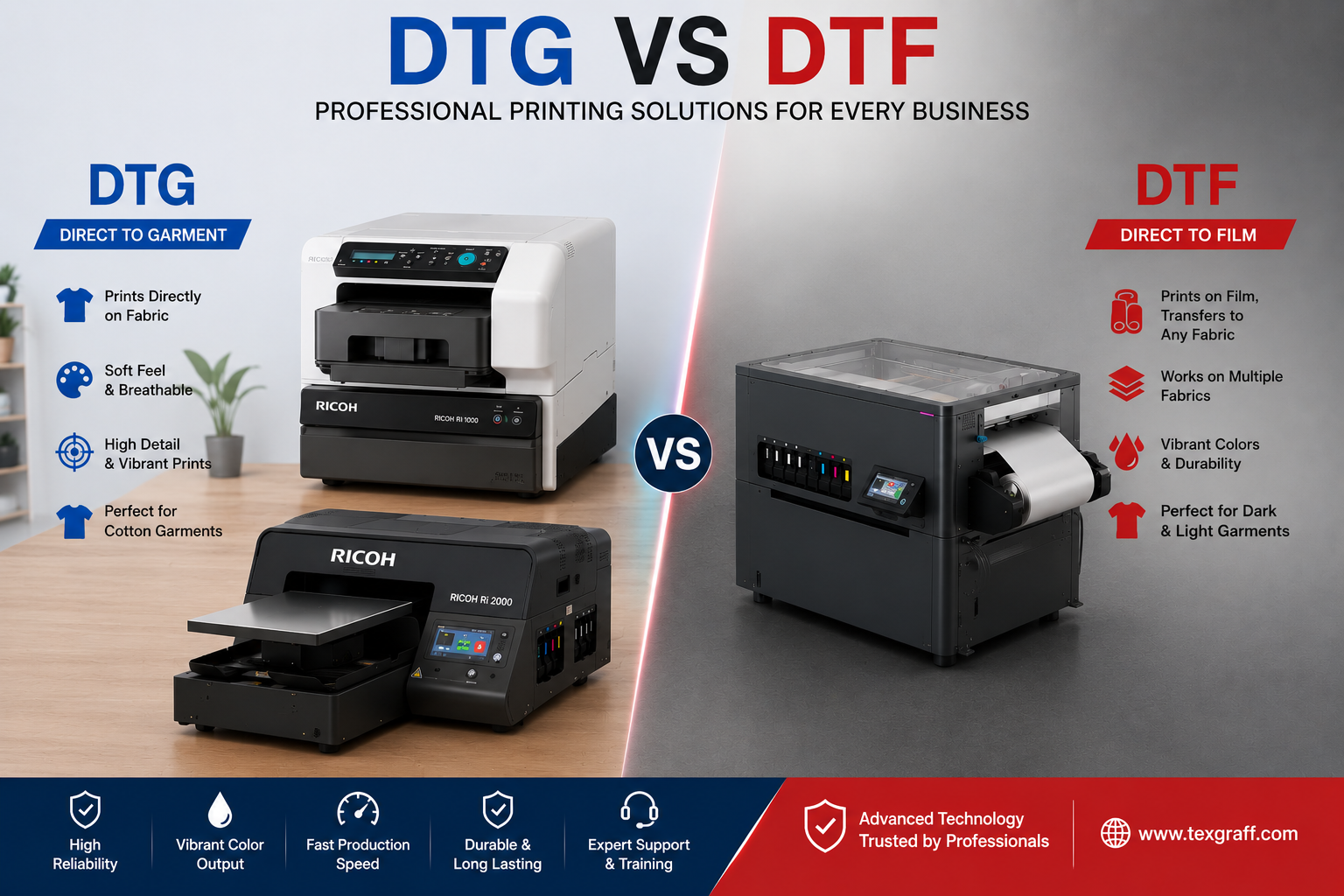
A DTG printer works like a specialized inkjet printer for textiles. It applies water-based inks directly onto the fabric (usually 100% cotton or high-cotton blends). This method is perfect for intricate, multi-color designs with no minimum order quantities.
Best Use Cases for DTG Printers:
- On-demand, single-piece printing
- Highly detailed photographic designs
- Soft, breathable prints with no extra layer
Top DTG Printer Models from TexGraff:
- RICOH Ri 1000X Textile Printer – A professional DTG desktop system that is also DTF ready for printing on transfer film, giving you dual flexibility.
- RICOH Ri 4000 DTG Printer – Features automatic inline pre-treatment for both cotton and polyester, applying pretreatment exactly where ink is applied. Extremely easy to use.
- RICOH Ri 2000 Printer – A high production DTG printer with a double carriage and 8 print heads, doubling speed up to 20 shirts/hour with automatic print height adjustment.
- RICOH Ri 100Lt Printer – The ultimate entry-level DTG printer for white garments. Low cost with a fast ROI.
Key Consideration: If you primarily print on dark garments or polyester, many DTG printers require pre-treatment. However, the Ri 4000 automates this process.
What is a DTF Printer? (Direct-to-Film)
A DTF printer prints your design onto a special PET film, which is then dusted with adhesive powder, cured, and heat-pressed onto any garment type (cotton, polyester, nylon, leather, etc.). DTF is rapidly growing because it removes fabric restrictions and pre-treatment hassles.
Best Use Cases for DTF Printers:
- Printing on difficult fabrics (polyester, nylon, blends)
- High-volume production with transfer films
- Small details and vibrant colors on dark garments
Top DTF Printer Models from TexGraff:
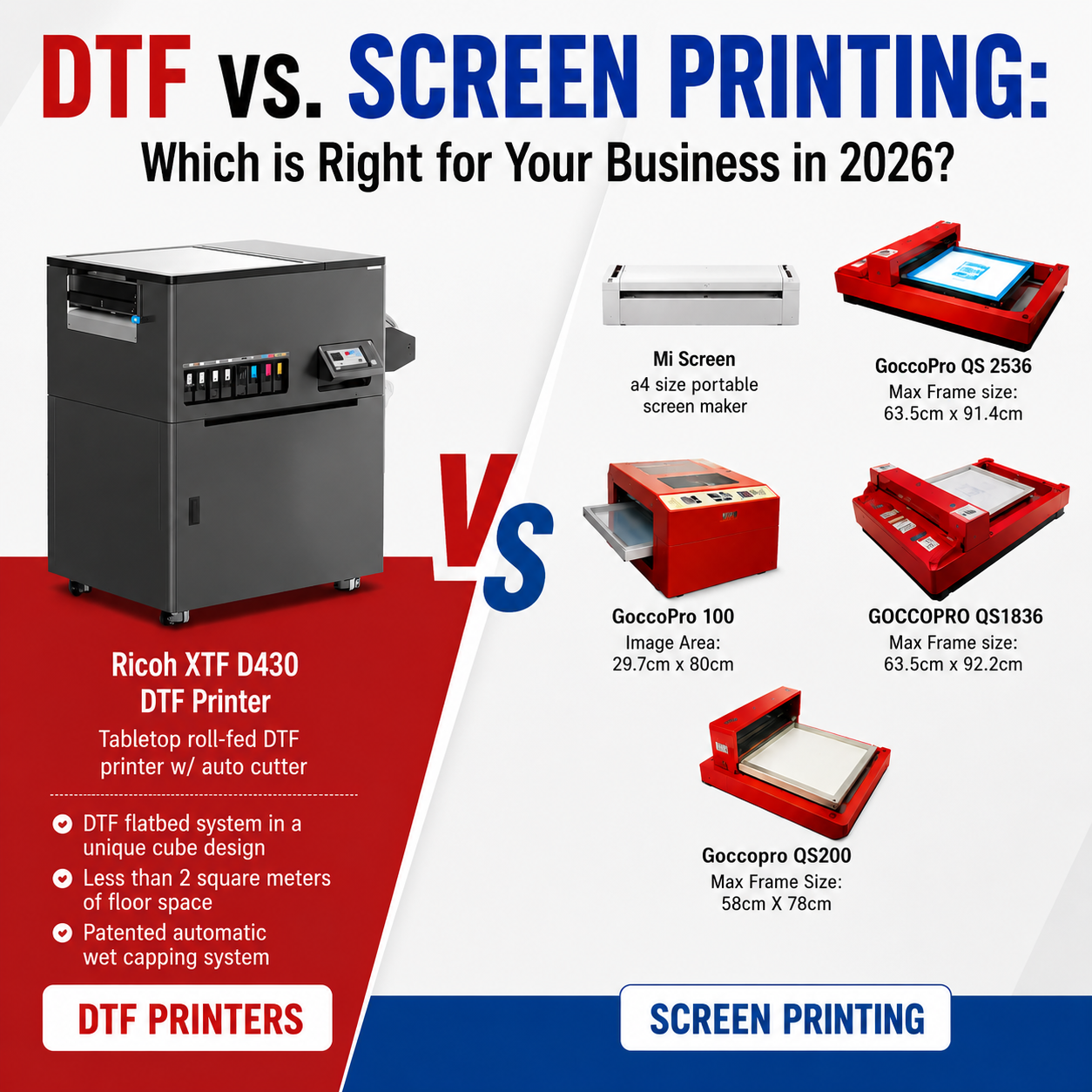
- Ricoh XTF D430 DTF Printer – A tabletop roll-fed DTF printer with auto cutter. This unique cube design takes less than 2 square meters of floor space and includes a patented automatic wet capping system.
- RICOH Pro D1600 Printer – A 1.3m wide DTF printer for high-volume production, reaching speeds up to 20m²/h with 3 Ricoh Gen5 industrial print heads. Industrial design made in Japan and Europe.
Pro Tip: DTF requires a heat press and a powder shaker/curing oven, but the payoff is incredible versatility across all garment colors and materials.
DTG vs. DTF: Direct Comparison
Feature | DTG Printer | DTF Printer |
Fabric Compatibility | Cotton, cotton-poly blends | Almost any fabric (cotton, poly, nylon, leather) |
Dark Garments | Requires pre-treatment | No pre-treatment, works perfectly |
Hand Feel (Softness) | Very soft, ink absorbs into fabric | Slightly raised (film layer) but durable |
Pre-Treatment Needed | Yes (except some high-end models) | No |
Production Speed | Slower (shirts/hour) | Faster (m²/hour) for transfers |
Startup Cost | Lower entry-level (Ri 100Lt) | Low to mid (tabletop DTF like XTF D430) |
Why Buy Your DTG or DTF Printer from TexGraff?
When you invest in a high-performance textile printer, you need more than just a machine. At TexGraff, you get:
- Authentic RICOH Technology – Known for reliability and print quality.
- Dual-Purpose Machines – The RICOH Ri 1000X is both a DTG printer and DTF ready.
- ROI Tools – Use our DTG/DTF ROI Calculator and Sublimation ROI Calculator to project your profits before buying.
- Complete Ecosystem – We also supply RIP software, heat press machines, and screen printing equipment.
Final Verdict: Which Should You Choose?
- Choose a DTG printer if your focus is on 100% cotton garments, single-piece custom orders, and ultra-soft hand feel (especially the Ri 2000 or Ri 4000 for production).
- Choose a DTF printer if you print on diverse materials (sports jerseys, polyester, nylon), want to skip pre-treatment, and need high-volume film transfers (the Pro D1600 is a powerhouse).
- Choose both – Invest in a RICOH Ri 1000X as a flexible DTG desktop system that’s DTF ready, then add a dedicated DTF printer like the XTF D430 as you scale.
Frequently Asked Questions (FAQ)
Q: Can I print DTF with a DTG printer?
A: Not directly. But some DTG printers (like the RICOH Ri 1000X) are DTF ready for printing on transfer film, meaning they can be used for both workflows with the right accessories.
Q: Which is more profitable – DTG or DTF?
A: It depends on your order mix. DTG excels for low-volume, all-cotton, high-detail jobs. DTF wins for mixed fabrics, dark garments, and higher throughput. Many shops run both.
Q: Do I need a heat press for DTF?
A: Yes – absolutely. DTF relies on a heat press to transfer the film image onto the garment. We offer a full range of heat transfer solutions.
Q: How long does a DTF print last on a garment?
A: With proper curing (correct heat press temperature and pressure), DTF transfers typically last 50–60+ home washes without cracking or fading. DTG prints also offer excellent durability on cotton but may show slight fading over time on dark garments.
Q: What’s the cost difference between DTG and DTF?
A: For small runs (1–10 pieces), DTF is often cheaper because there’s no pretreatment waste and you can gang multiple designs on one film. For larger cotton runs, DTG becomes more economical. Use TexGraff’s DTG/DTF ROI Calculator for exact numbers based on your ink and labor costs.
Q: Can I use the same RIP software for both?
A: Yes, most modern RIP software supports both workflows. However, you’ll need separate profiles – one for direct textile printing and another for DTF film with white ink underbase. TexGraff provides RIP with every printer purchase.